

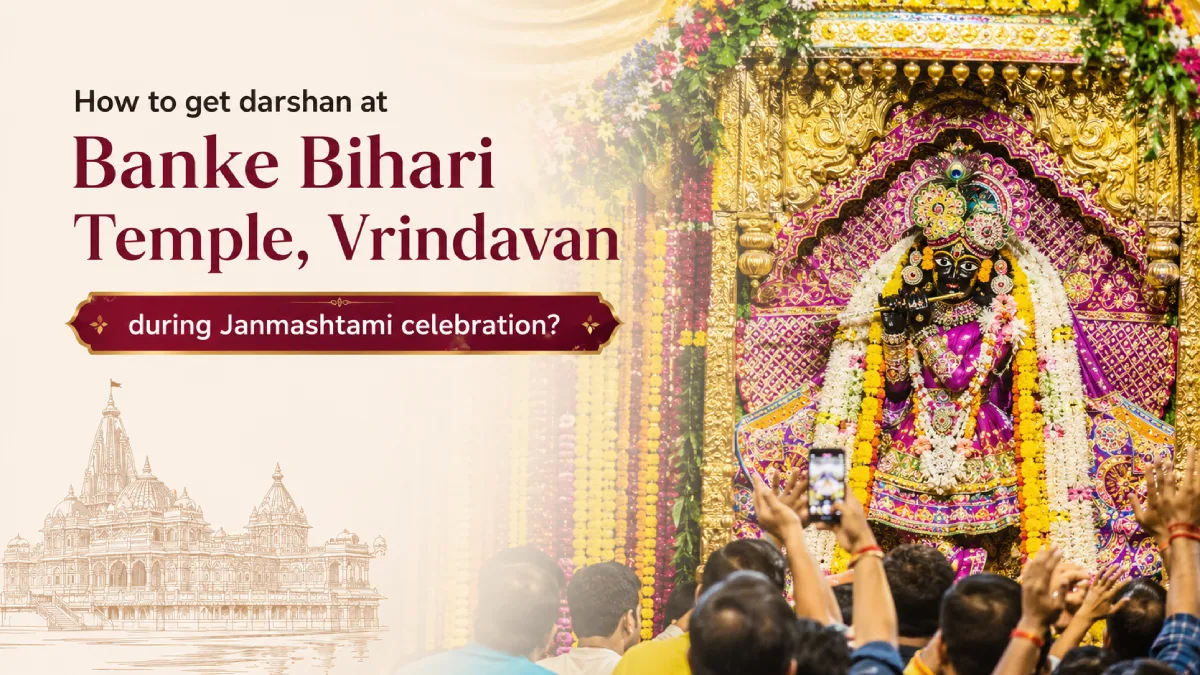
Banke Bihari Mandir does not perform a Mangala Aarti on any day of the year- except one. Janmashtami. This single exception makes the midnight darshan at Banke Bihari Temple one of the most sought-after spiritual experiences in all of India. If you are planning to be part of it in 2026, this guide will tell you everything you need to know- when to arrive, where to stand, what to expect, and how not to get lost in one of the most intense crowds you will ever witness. If you are planning Braj travel around a larger religious gathering, the Kumbh Mela 2027 date and place are worth knowing when you fix your dates.
Who is Banke Bihari Ji? Why This Temple is Different
In the narrow, incense-filled lanes of Vrindavan stands a temple unlike any other in India. Banke Bihari Mandir, established in 1864 by the descendants of the great saint-musician Swami Haridas, houses Lord Krishna in his most captivating form- the Tribhanga posture, bent at three points, flute-playing, eternally playful.
The name tells you everything: Banke (bent in three places) Bihari (one who wanders in pleasure). This is not the warrior Krishna of Mahabharata. This is the beloved of Vrindavan- the butter-thief, the flute player, the enchanter of hearts. Pilgrims say that a single glance from Bihari Ji is enough to dissolve a lifetime of sorrow.
Find This: Holi Celebration in Vrindavan
The Jhanki Tradition- Unique to This Temple Alone
Banke Bihari is the only major temple in India where the deity is not shown continuously. A curtain (the parda) is drawn and opened repeatedly- every few seconds- giving devotees brief, piercing glimpses of the Lord. The tradition exists because the priests believe Bihari Ji’s direct, unbroken gaze would overwhelm devotees completely. Each opening of the curtain is called a jhanki, and pilgrims describe the anticipation between each reveal as a kind of devotional heartbeat.
Every day except Janmashtami, there is no Mangala Aarti (the dawn aarti performed at virtually every other temple). Bihari Ji is said to wake up late- like any beloved child. The temple opens at 7:45 AM in summer, 8:45 AM in winter, and devotees have learned to love this rhythm. But on Janmashtami night, everything changes.
Janmashtami 2026: Date, Timings & The Birth Moment
| Janmashtami Date 4 September 2026 Ashtami Tithi begins 2:25 AM on 4 Sep | Nishita Kaal (Birth Moment) 11:46 PM – 12:27 AM The 41 minutes when all of Braj erupts | ISKCON Vrindavan Celebrates 5 September 2026 Per Vaishnava calendar tradition |
| Nandotsav (Day After) 5 September 2026 Grand celebrations in Gokul | Celebrations Begin In Vrindavan 10 Days Prior Rasleelas, bhajans, temple decorations | Expected Pilgrims in Braj 30–50 Lakh Across both days in Mathura–Vrindavan |
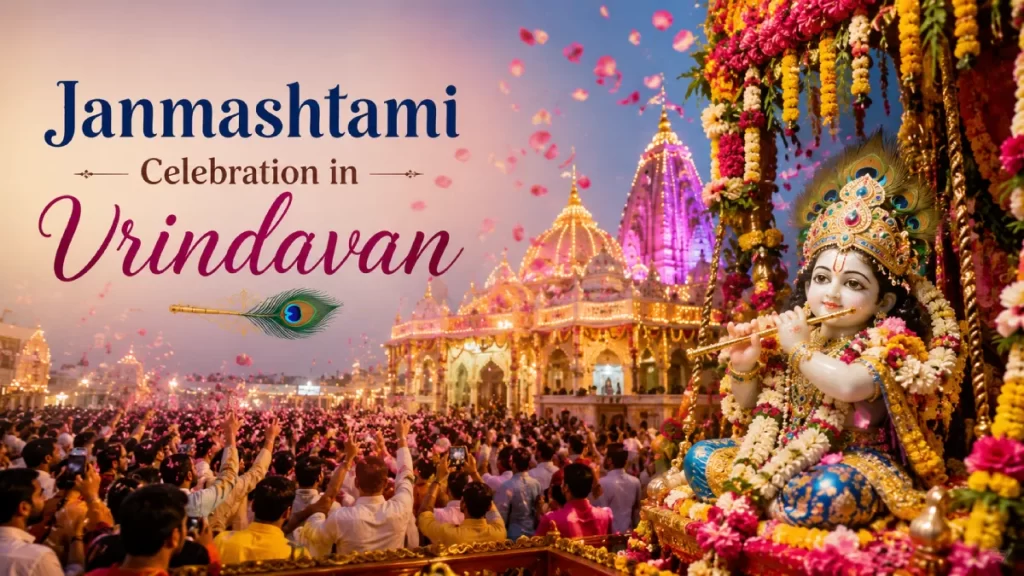
Janmashtami in Vrindavan is not a single midnight event- it is a full two-day devotional experience. The lanes of Vrindavan begin filling from the morning of 3 September. By 4 September evening, all major roads into the city are under police crowd control. The Banke Bihari lane becomes one of the most densely packed stretches of humanity you will ever stand in.
“When the Nishita Kaal arrives and every conch blows at once across Vrindavan, you will not remember your name, your city, or your phone. You will only know the sound of Jai Shri Krishna.”
The Mangala Aarti: Why It Happens Only on Janmashtami
On every ordinary day, Banke Bihari sleeps late, and the temple honours this. No dawn bells, no Mangala Aarti, no forceful awakening. But on Janmashtami- the night of his own birth- Bihari Ji wakes for the only time all year before sunrise. The midnight Mangala Aarti at Banke Bihari is the single most emotionally charged event of the entire Braj festival calendar.
| AARTI | TIME (JANMASHTAMI) | NOTES |
| Mangala Aarti | ~12:00 AM (midnight, 4–5 Sep) | Once a year only |
| Shringar Aarti | Extended/special decoration | Bihari Ji dressed in special Janmashtami shringar |
| Rajbhog Aarti | Extended for Janmashtami bhog | Chappan Bhog (56 food offerings) presented |
| Shayan Aarti | Extended Hours | All-night celebrations |
Warning- Crowds at the Midnight Aarti
The lane leading to Banke Bihari during the midnight Aarti sees crowd density that makes movement nearly impossible after 9 PM. Streets in old Vrindavan are as narrow as 4 metres. If you plan to attend the midnight Aarti, you must be inside the temple premises or in the direct approach lane no later than 8:30 PM on 4 September. Arriving after 10 PM makes reaching the temple door virtually impossible.
10 Proven Tips to Get Banke Bihari Darshan During Janmashtami
- Arrive in Vrindavan by 3 September (the day before). Transport into the city begins getting restricted from the afternoon of 4 September. If you arrive on Janmashtami day itself, you may find yourself stuck on the highway hours from Vrindavan.
- Reach the Banke Bihari lane by 8:30 PM at the latest for the midnight Aarti. The famous narrow lanes of old Vrindavan- especially Bihari Ji lane are impassable by 10 PM on Janmashtami. Every minute past 9 PM adds approximately 30 minutes to your queue time. The most crucial element for darshan at Banke Bihari Temple is arrival time. If you manage to get early around 2-3 AM and reach temle premises to get in darshan queue, there are chances to get darshan of Bihari Ji in 2-3 hours.
3. Go on foot or e-rickshaw only. No private vehicle can enter the inner lanes near Banke Bihari. Park at designated points near Keshi Ghat road or the ISKCON area and walk the final 300–500 metres. E-rickshaws from Mathura–Vrindavan road to the temple area are your best option.
4. Do not search for a VIP pass- it does not exist. Banke Bihari Temple has no official VIP or priority darshan system. Any agent offering paid “VIP darshan” or “fast-track entry” at Banke Bihari is a tout. Walk past politely. Darshan is free for everyone.
5. Move with the crowd, not against it. The crowd inside the darshan hall moves in waves- resist it and you will feel crushed. Surrender to the flow and you will find yourself carried, gently but inevitably, to the jhanki. Experienced pilgrims call this bhakti ka pravah– the current of devotion.
6. Wear simple, fitted clothing. No dupatta, chunni, or large stoles that can get caught in the crowd. Fitted kurta-pyjama or salwar for women. Minimal loose fabric. Keep a firm grip on children at all times- the crowd is dense.
7. Leave mobiles, cameras, and bags outside or at your hotel. Mobile phones and large bags are not permitted inside the darshan hall. The temple has cloakroom facilities. Large bags slow your movement and create friction in a dense crowd. Travel as light as possible.
8. Stay hydrated but carry water in a compact bottle only. The heat and crowd density create intense physical strain. Carry one small 500ml bottle. Avoid eating heavy meals before entering the crowd. ORS sachets in a pocket are a wise preparation.
9. For morning darshan on Janmashtami day, arrive before 7 AM. The temple opens early on Janmashtami for special morning rituals. If the midnight crowd is too daunting, the early morning window on 4 September (before 8 AM) offers a significantly calmer experience while still capturing the Janmashtami energy.
10. Book a room within 500 metres of Banke Bihari- at least 3 months in advance. This is perhaps the single most important logistical decision. Hotels and dharamshalas within walking distance of the temple are the first to sell out, sometimes 4–5 months before the festival. Being 500 metres away means you can join the crowd at the exact right moment and retreat quickly if needed. You can wake up very early in Brahm Muhurt and get first darshan at Temple.
Suggested Read: Holy Ghats in Mathura Vrindavan for a Beautiful Evening
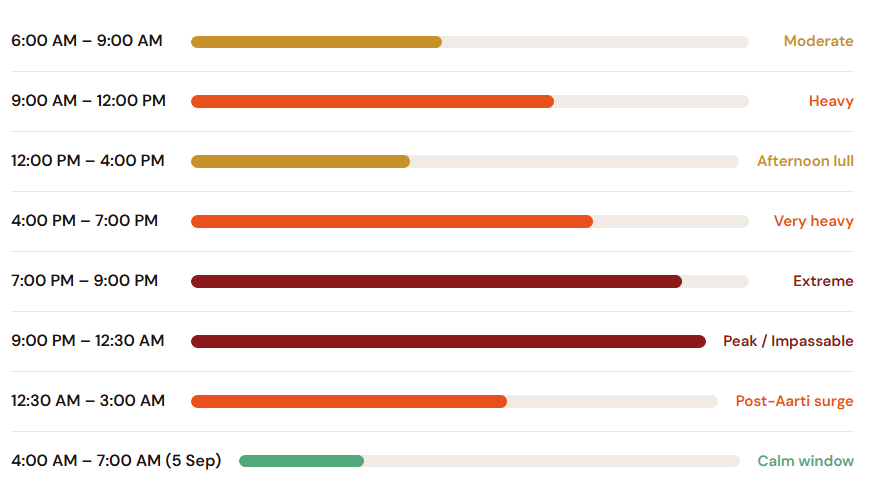
Banke Bihari Crowd Guide: What to Expect Hour by Hour on Janmashtami
Hidden Gem Timing
The 4:00 AM – 7:00 AM window on 5 September morning is the best-kept secret in Vrindavan. After the midnight celebrations, most pilgrims retreat to rest. The temple sees its calmest hours of the entire two-day festival in this window and you can still feel the entire spiritual electricity of Janmashtami still hanging in the air. If you can manage the sleep sacrifice, this is your darshan.
How to Reach Banke Bihari Temple, Vrindavan?
| 🚆 From Delhi / NCR By Car (Yamuna Expressway): ~145 km, 2.5–3 hours. On Janmashtami, add 1–2 hours for traffic. By Train: Delhi → Mathura Junction (1.5–2 hrs on Rajdhani/Intercity). Then auto/e-rickshaw to Vrindavan (12 km, 30 min). Nearest Station: Mathura Junction (12 km) or Vrindavan Railway Station (closer but fewer trains) Book a cab in advance: Ola/Uber surge pricing on Janmashtami. Pre-book a cab from Delhi by 2 September. | 🛺 Mathura to Banke Bihari Distance: ~12 km from Mathura Junction Best option: E-rickshaw from Chhatikara Road to Bhuteshwar area, then walk / e-rickshaw to temple lane Avoid: Auto-rickshaws on Janmashtami- roads are closed to most vehicles after 6 PM Last stretch: 300–500 metres on foot from Keshi Ghat / ISKCON road only |
Road Closures on Janmashtami
From approximately 6 PM on 4 September, the UP Police closes major roads entering Vrindavan to private vehicles. If you are arriving from Delhi by car on Janmashtami evening, park near Mathura Junction or the designated areas outside Vrindavan and complete the last leg by e-rickshaw or on foot. Do not plan to drive to the temple on the night of the festival.
Janmashtami Celebrations in Vrindavan: A Day-by-Day Guide
- 10 Days Before Janmashtami: Jhulan Yatra Ends, Decorations Begin The five-day swing festival (Jhulan Yatra) concludes, giving way to Janmashtami preparations. Temples begin elaborate floral decorations. Rasleela troupes perform nightly across Vrindavan’s open stages.
- 3 Sep Day Before: Bhakti Begins, Pilgrims Pour In All-night kirtan begins at major temples. Bhajans echo from every lane. This is the ideal arrival day- before roads are restricted. The city already thrums with devotional electricity.
- 4 Sep Janmashtami Day: Fasting, Decoration, All-Day Darshan Devotees observe a complete fast until midnight. Temples open with special decoration darshan in the morning. At Banke Bihari, Bihari Ji is dressed in exquisite Janmashtami shringar- jewelled crown, peacock feather, flower garlands. The Chappan Bhog (56-dish offering) is prepared by the Goswami family.
- 9 PM Janmotsav Build-Up: The City Transforms Every street is lit. Every temple is decorated. Conches blow at intervals from 9 PM onward as the birth moment approaches. The chant of Hare Krishna, Hare Rama rises and falls in waves across all of Vrindavan simultaneously.
- 11:46 Nishita Kaal: The 41 Most Sacred Minutes of the Year 11:46 PM to 12:27 AM- the astrologically confirmed birth window. Bells, conches, and drums explode across every temple simultaneously. At Banke Bihari, the one-and-only Mangala Aarti is performed. At Krishna Janmabhoomi in Mathura, the Panchamrit abhishek of the deity takes place. Devotees break their fast only after this moment.
- 5 Sep ISKCON Celebration + Nandotsav in Gokul ISKCON Vrindavan (per Vaishnava tithi) celebrates on 5 September with grand abhishek, continuous kirtan, and prasad distribution to over 1 lakh pilgrims. Gokul hosts the Nandotsav- a more intimate, joyful celebration of Nanda Baba’s delight at Krishna’s birth. Fewer crowds than Vrindavan, an authentic atmosphere.
Accommodation Options in Vrindavan for Janmashtami
Book at least 3–4 months before Janmashtami. Hotels within 500 metres of Banke Bihari Mandir and along the Mathura–Vrindavan belt sell out first. Below is a practical range of options:
| Dharamshala / Free Ashrams ₹0 – ₹300 Basic but clean. Managed by religious trusts. Bed and bathroom only. Ideal for solo pilgrims. Book through the temple trust or the Vrindavan municipal board. | Budget Guesthouses ₹500 – ₹1,500 Many small guesthouses in the Banke Bihari lane area. Basic AC rooms. On Janmashtami, even these surge in price — book far in advance. | Mid-Range Hotels ₹2,000 – ₹5,000 Hotels in the Bhaktivedanta Marg / Raman Reti area. Clean, AC, meals included in some packages. Book through platforms like MakeMyTrip or directly. | Mathura Hotels ₹2,500 – ₹7,000 Staying in Mathura (12 km) gives more options and slightly lower prices. Travel by cab to Vrindavan for darshan. Better option if Vrindavan is fully booked. | Luxury / Heritage Stays ₹8,000+ A handful of premium properties near the Yamuna Expressway corridor and in Agra (60 km) offer comfort and easy access. Ideal for families with elderly members. |
The Golden Rule
On Janmashtami, your hotel’s proximity to the temple is more valuable than any star rating. A ₹600 guesthouse 300 metres from Banke Bihari is worth more than a ₹8,000 hotel 10 km away. Book closed. Book early.
What to Eat During Janmashtami in Vrindavan?
Vrindavan during Janmashtami is a feast for devotees- both spiritual and literal. The tradition of anna daan (food donation) runs so deep here that you will be offered prasad and food at virtually every step.
Langar Seva: Hundreds of langars operated by religious organizations, trusts, and individuals line both trekking routes and are set up across Vrindavan’s lanes during Janmashtami. ISKCON alone distributes over 1 lakh plates of prasad on Janmashtami. All food is free, vegetarian, and prepared with immense care. Khichdi, dal, puri-sabzi, kheer, and sweet rice are the most common langar items.
Chappan Bhog: The 56-dish offering made to Bihari Ji on Janmashtami is one of the most elaborate food rituals in Hinduism. After it is offered to the deity, portions are distributed as prasad. Receiving this Chappan Bhog prasad on Janmashtami is considered deeply auspicious.
Faraali food during the fast: Since most devout pilgrims fast on Janmashtami until midnight, street stalls all over Vrindavan sell faraali (fast-friendly) food- sabudana khichdi, singhare ki puri, fruit chaat, aloo ki tikki, and samak rice. These are available from early morning and are both filling and permissible during the Janmashtami vrat.
🌿 Food Tips
Vrindavan is fully vegetarian- there are no non-vegetarian food establishments in the city. Carry dry snacks (dry fruits, chikki, energy bars) for the midnight wait, as stalls may be crowded or inaccessible. Stay hydrated- the combination of fasting, heat, and crowd density can cause sudden weakness.
Places to Visit Around Vrindavan During Janmashtami
Banke Bihari Mandir is the heart- but Vrindavan’s Janmashtami experience extends far beyond one temple. Pair your darshan with these nearby sacred experiences:
ISKCON Vrindavan
Grand midnight abhishek, continuous kirtan, and international devotees. Celebrated on 5 Sep per Vaishnava calendar.
Prem Mandir
Magnificently lit marble temple, especially stunning during Janmashtami night. Evening light show at 7:30 PM.
Keshi Ghat (Yamuna)
Thousands of diyas float on the Yamuna at midnight. One of the most visually breathtaking sights of the festival.
Nidhivan
Sacred grove where Krishna is said to perform the Raas Leela at night, even today. Deeply mysterious atmosphere.
Radha Raman Temple
One of the most authentic, uncommercialized Vrindavan temples. The self-manifested Shaligram deity is extraordinary.
Madhuban Rasleela
Professional Rasleela performances near the Yamuna depict Krishna’s childhood leelas. Daytime-only during Janmashtami.
Krishna Janmabhoomi, Mathura
The actual birthplace of Lord Krishna, 12 km away. The midnight Panchamrit abhishek here is the centerpiece event of Janmashtami.
Seva Kunj
Sacred grove associated with Radha-Krishna’s divine Raas. Filled with devotional energy during the Janmashtami season.
Find This: How to plan Braj 84 Kos Parikrama?
📅 Suggested 2-Day Plan
3 September (Day 1): Arrive, check in, visit Banke Bihari for evening darshan (6 PM – 8 PM) before crowds peak. Explore Prem Mandir and Keshi Ghat by night. Planning this tour with your group, hire a Tempo Traveller in Delhi for Vrindavan that will help to roam across all places in Brajbhoomi very easily.
4 September (Janmashtami): Morning darshan at Radha Raman (6 AM). Rasleela at Madhuban (3 PM). In position at Banke Bihari lane by 8 PM for midnight Mangala Aarti. Keshi Ghat diyas post-midnight. Sleep at 2 AM. Optional: 4 AM calm darshan at Banke Bihari.
5 September (Nandotsav): ISKCON Vrindavan grand celebration. Travel to Krishna Janmabhoomi in Mathura if not visited. Optional: Gokul (14 km) for the most authentic Nandotsav.
Know Here: 12 Seater Tempo Traveller Rate in Delhi for 3 Days Mathura Vrindavan Trip
Things Nobody Tells You About Janmashtami in Vrindavan
- 📡BSNL network works best inside old Vrindavan. Airtel and Jio get congested beyond capacity during Janmashtami night. If you rely on your phone for navigation or communication, get a BSNL SIM before arriving.
- 💵Carry sufficient cash in small denominations. ATMs near the temple run out of cash by afternoon on Janmashtami. Carry ₹2,000–3,000 in cash for prasad, food, donations, and transport. UPI works but networks are unreliable in the crowd.
- 🐒Watch for monkeys. Vrindavan has a large monkey population. Keep bags closed, do not hold food visibly, and remove glasses frames gently (monkeys have learned to grab them). This applies at all temples year-round but is relevant to first-time visitors.
- 👟Wear footwear you can slip off instantly. You will remove shoes at every temple entrance. Slip-on footwear (flip-flops, sandals with heel strap) is far more practical than lace-up shoes. Use a footwear token system at larger temples to avoid confusion.
- 🎯The afternoon lull (12 PM – 4 PM) on Janmashtami is underrated. Most pilgrims rest during these hours. If you want to visit Prem Mandir, ISKCON, or Radha Raman without extreme crowds, this is your window and the temples are still beautifully decorated.
