

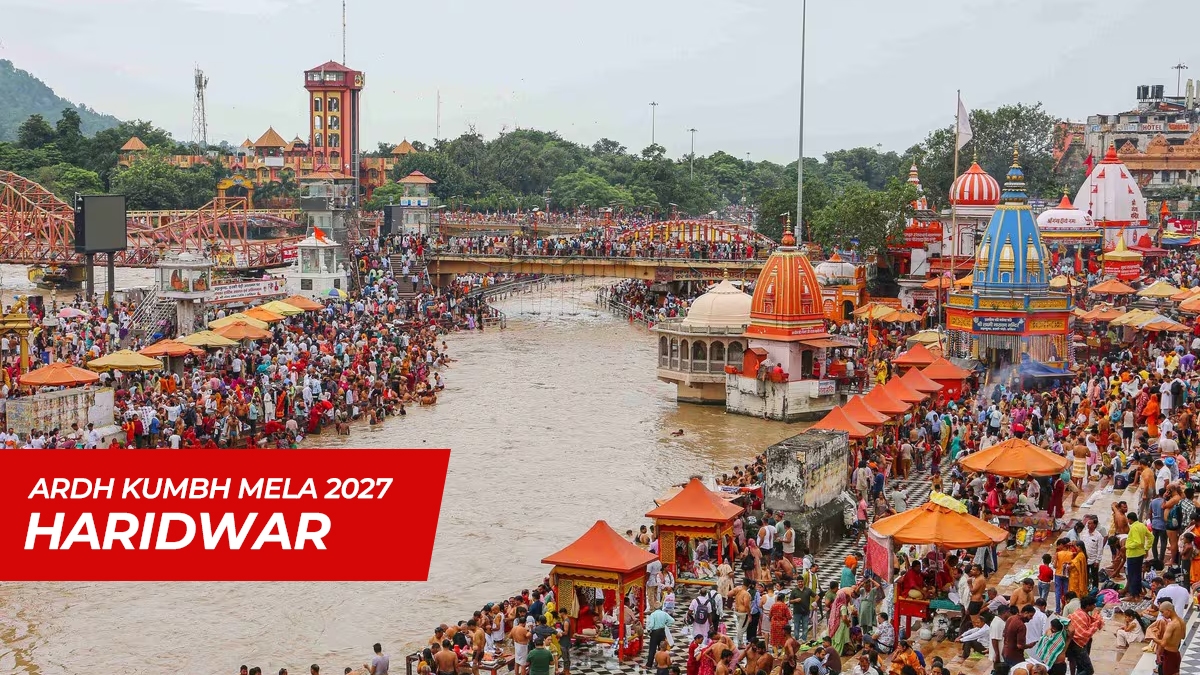
Haridwar is calling. The Ganga is waiting. And in January 2027, millions will answer.
There are few events on earth that can genuinely be called once-in-a-lifetime. The Ardh Kumbh Mela is one of them- not because it is rare in the conventional sense, but because every edition carries its own spiritual weight, its own energy, its own particular brand of human magnitude. And the 2027 edition, set to unfold along the banks of the sacred Ganga in Haridwar, is shaping up to be one of the most significant gatherings in recent memory.
Coming just two years after the historic Maha Kumbh 2025 in Prayagraj, which drew an extraordinary 66 crore pilgrims and broke every record in the history of human congregation, the Ardh Kumbh Mela 2027 arrives with enormous expectation and profound spiritual purpose. Here is everything you need to know.
What is Ardh Kumbh Mela?
The word Ardh means ‘half’ and the Ardh Kumbh is held at the midpoint of the twelve-year Purna Kumbh cycle, making it a six-yearly event. Unlike the Purna Kumbh and Maha Kumbh, which rotate across four sacred cities- Prayagraj, Haridwar, Nashik, and Ujjain- the Ardh Kumbh is held only at Haridwar and Prayagraj.
The Kumbh tradition draws from one of Hinduism’s most ancient myths: the Samudra Manthan, or churning of the cosmic ocean, in which gods and demons together sought the pot of immortal nectar (amrit). During the ensuing struggle for possession of the nectar, four drops fell to earth- at Haridwar, Prayagraj, Nashik, and Ujjain. These four cities became the sacred Kumbh sites, and it is believed that bathing in their holy rivers during the auspicious Kumbh period cleanses the soul of accumulated sins and opens the path toward moksha– spiritual liberation.
The 2027 Ardh Kumbh follows the 2021 Haridwar Kumbh, which was held under the long shadow of the COVID-19 pandemic with significantly reduced participation. In contrast, 2027 is expected to return in full, glorious force, with projections of over 10 crore pilgrims attending across the duration of the mela.
Dates: When is Ardh Kumbh 2027?
The Ardh Kumbh Mela 2027 will be held in Haridwar, Uttarakhand, from 14 January to 20 April 2027– a period of nearly three and a half months. Dates are determined according to the Vikram Samvat calendar and correspond to specific astrological configurations of Jupiter, the Sun, and the Moon.
The festival opens on Paush Purnima (Makar Sankranti) on 14 January and concludes on Chaitra Purnima on 20 April 2027.
Key Bathing Dates (Snan Dates)
| Date | Occasion |
| 14 January 2027 | Makar Sankranti — Opening Snan |
| 06 February 2027 | Mauni Amavasya |
| 11 February 2027 | Vasant Panchami |
| 20 February 2027 | Magh Purnima |
| 06 March 2027 | Amrit Snan- Mahashivratri |
| 08 March 2027 | Amrit Snan- Phalguna Amavasya |
| 07 April 2027 | Nav Samvatsar |
| 14 April 2027 | Amrit Snan- Mesh Sankranti (Baisakhi) |
| 15 April 2027 | Shri Ram Navami |
| 20 April 2027 | Chaitra Purnima- Closing Snan |
Each of these dates carries deep astrological and religious significance. Crowd numbers surge dramatically on snan days, particularly on Mauni Amavasya and Mahashivratri, which are considered among the most powerful bathing dates in the Hindu calendar.
The Shahi Snan: The Royal Bath
If there is one event within the Kumbh that defines its visual and spiritual grandeur, it is the Shahi Snan– the royal ceremonial bath. This is not simply a personal act of devotion but a magnificent public ritual performed by the saints and sadhus of the thirteen Akharas, the ancient monastic orders of Hinduism.
The 2027 Ardh Kumbh is notable for featuring four Shahi Amrit Snan events- a first for an Ardh Kumbh in Haridwar. All thirteen Akharas have already confirmed their participation and agreed on the schedule, a significant logistical achievement given the complex hierarchy and protocols involved.
The Shahi Snan begins with elaborate processions- Peshwais in which Naga Sadhus ride on horseback and elephants, accompanied by decorated chariots, traditional music, conch shells, and the chanting of ancient hymns. These processions move through Haridwar’s streets toward Har-ki-Pauri, where the actual bathing takes place in a carefully choreographed order of Akhara precedence. The entire spectacle is one of the most visually extraordinary cultural traditions anywhere in the world, drawing photographers, filmmakers, and cultural observers alongside the millions of ordinary devotees.
The Naga Sadhus- ash-smeared, dreadlocked, and renunciant are among the most iconic figures of the Kumbh. Many spend years in forests, mountains, and ashrams, and the Kumbh is one of the rare occasions when they emerge in great numbers to take the sacred bath.
Where it Happens: Haridwar
Haridwar, which translates as Gateway to God (Hari = Vishnu/God, Dwar = gate), is one of Hinduism’s most sacred cities. It sits in the foothills of the Himalayas, at the precise point where the Ganga descends from the mountains onto the plains, a geographical and spiritual threshold that has drawn pilgrims for thousands of years.
The city’s spiritual heart is Har-ki-Pauri– the Steps of God– a ghat where, according to tradition, the footprint of Lord Vishnu is preserved in stone. This is where the main bathing takes place during the Kumbh, and where the nightly Ganga Aarti transforms the river into a sea of floating lamps and devotional fire every single evening of the year.
During the Ardh Kumbh Mela, Haridwar transforms entirely. A temporary city emerges alongside the permanent one- a vast infrastructure of tents, pontoon bridges, roads, service centres, medical camps, and Akhara settlements that can accommodate millions of visitors at a time. The river and the city become inseparable during these months, the Ganga no longer a backdrop but the living centre of everything.
Find Here: Delhi to Haridwar Trip Route
What Makes 2027 Special?
Several factors make the 2027 Ardh Kumbh particularly significant.
Recovery and return after 2021: The previous Haridwar Kumbh in 2021 was held during the COVID-19 pandemic and operated at a dramatically reduced scale. The 2027 edition represents the full restoration of this ancient tradition, with all Akharas, all rituals, and full public participation restored.
Four Shahi Amrit Snans: The 2027 edition will be the first Ardh Kumbh in Haridwar to feature four Shahi Amrit Snan dates, adding an additional layer of spiritual and ceremonial significance.
Advanced infrastructure: The Uttarakhand government is implementing significant upgrades, including AI-powered crowd management systems, improved sanitation networks, expanded ghat facilities, better rail and road connectivity, and digital services for pilgrims, including real-time crowd monitoring and lost-and-found systems.
Global footprint: The Kumbh now draws visitors from across the world- not only Hindu pilgrims but spiritual seekers, anthropologists, journalists, photographers, and travellers from dozens of countries who come to witness what remains the largest peaceful human gathering on earth.
If you are also looking for Chardham Yatra in 2027, book Chardham Yatra Packages from Haridwar for all-inclusive things.
How to Reach Ardh Kumbh Mela Location?
By Air: The nearest airport is Jolly Grant Airport in Dehradun, approximately 40 km from Haridwar. International travellers typically fly into Delhi’s Indira Gandhi International Airport (around 230 km away) and continue by train or road.
By Rail: Haridwar Junction is one of northern India’s busiest and best-connected stations, with direct trains from Delhi, Mumbai, Kolkata, Lucknow, Chennai, and most major cities. Booking well in advance is essential during the Kumbh period, as trains fill up rapidly around the major snan dates.
By Road: Haridwar is accessible via National Highway NH-58 from Delhi, a journey of approximately four to five hours depending on traffic. State and private bus services also run regularly from Delhi, Dehradun, and the surrounding areas. If you are planning a trip from Delhi, booking Tempo Traveller on rent in Delhi is one of the best choice.
Where to Stay in Haridwar?
Accommodation options during the Ardh Kumbh range across every budget and preference.
Hotels, from budget to luxury, are concentrated in Haridwar’s main areas. Ashrams and dharamshalas offer inexpensive, often spiritually immersive stays- many provide basic meals as part of the experience. GMVN guesthouses (Garhwal Mandal Vikas Nigam) are government-run and reliable. Tent cities– both government-managed and privately operated are set up along the banks of the Ganga specifically for Kumbh visitors and offer everything from basic accommodation to semi-luxury camps.
Book at least six to eight months in advance. On the key snan days, especially Mauni Amavasya and Mahashivratri, accommodation within the city becomes extraordinarily scarce. Many pilgrims choose to stay in nearby Rishikesh (25 km) and commute on snan days.
The total budget for the Haridwar trip depends on your accommodation, transportation, stay duration and other related activities. If you are also planning to explore places near Haridwar and want a custom itinerary, book tempo traveller in Haridwar at per km rate for a budgeted trip.
A Suggested Itinerary
Day 1: Arrive in Haridwar. Check in and attend the Ganga Aarti at Har-ki-Pauri at sunset- one of the most moving ceremonies in India.
Day 2: Take a holy bath on an auspicious snan day. Visit the Mansa Devi and Chandi Devi temples via ropeway. Explore the Akhara camps in the late afternoon.
Day 3: Attend spiritual discourses, witness traditional rituals at the ghats, and spend time in the Akhara settlements- many of which are open to respectful visitors and offer a window into centuries-old monastic traditions.
Day 4: Day trip to Rishikesh- Visit Lakshman Jhula, Parmarth Niketan, the Beatles Ashram, and take in the quieter, more contemplative energy of yoga’s global capital.
Day 5: Morning meditation or yoga session by the Ganga, final visit to Har-ki-Pauri, and departure.
Get to Know: Delhi to Haridwar Tempo Traveller Rates
Practical Tips for Visitors
Dress modestly. The Kumbh is a deeply religious space. Conservative, modest clothing is expected and appreciated at all ghats and temple areas.
Carry minimal valuables. Crowds on peak snan days are enormous. Keep cash, phones, and documents secure in a money belt or locked accommodation.
Stay hydrated and plan for crowds. Peak days can see tens of millions of visitors. Move early, avoid rush hours near the ghats, and always have a meeting point arranged if travelling in a group.
Respect the rituals. Photography is generally permitted but always ask before photographing sadhus or private ceremonies. The Shahi Snan in particular is sacred- observe with reverence.
Plan for medical emergencies. Medical camps are available throughout the mela grounds. Carry basic medicines, especially if travelling with elderly pilgrims or children.
To plan a trip in extra luxury and comfort, you can also go for Urbania Van booking in Haridwar– available at best rates.
The Bigger Picture
The Ardh Kumbh is ultimately not an event that can be adequately described. It is one of those rare human experiences that exceeds all preparation and expectation simultaneously- a living demonstration of faith at a scale that defies the rational mind. Whether you arrive as a devout Hindu seeking the liberating dip in the Ganga, or as a curious traveller drawn by the spectacle of human devotion, Haridwar in January 2027 will leave something behind in you that no ordinary journey can.
The Ganga flows endlessly, as it has for millennia. The pilgrims keep coming, as they have for generations beyond counting. And for a few months in 2027, the world’s most ancient spiritual tradition will gather once again at the foothills of the Himalayas and the sight of it will be unlike anything else on earth.

What a beautifully written piece on Ardh Kumbh Mela 2027! One thing pilgrim often underestimate is the travel logistics Prayagraj during Mela season is an entirely different beast with road diversions, parking restrictions, and massive footfall. For Delhi devotees and groups, the most practical solution we’ve seen work seamlessly is booking a tempo traveller on rent fits 9 to 26 passengers, handles luggage comfortably, and a reliable driver who knows the Mela routes saves enormous stress. At Delhi Tempo Travels we’ve been handling Kumbh group travel for years and the demand is unlike any other pilgrimage. Start planning early vehicles get booked months in advance for Kumbh season!