

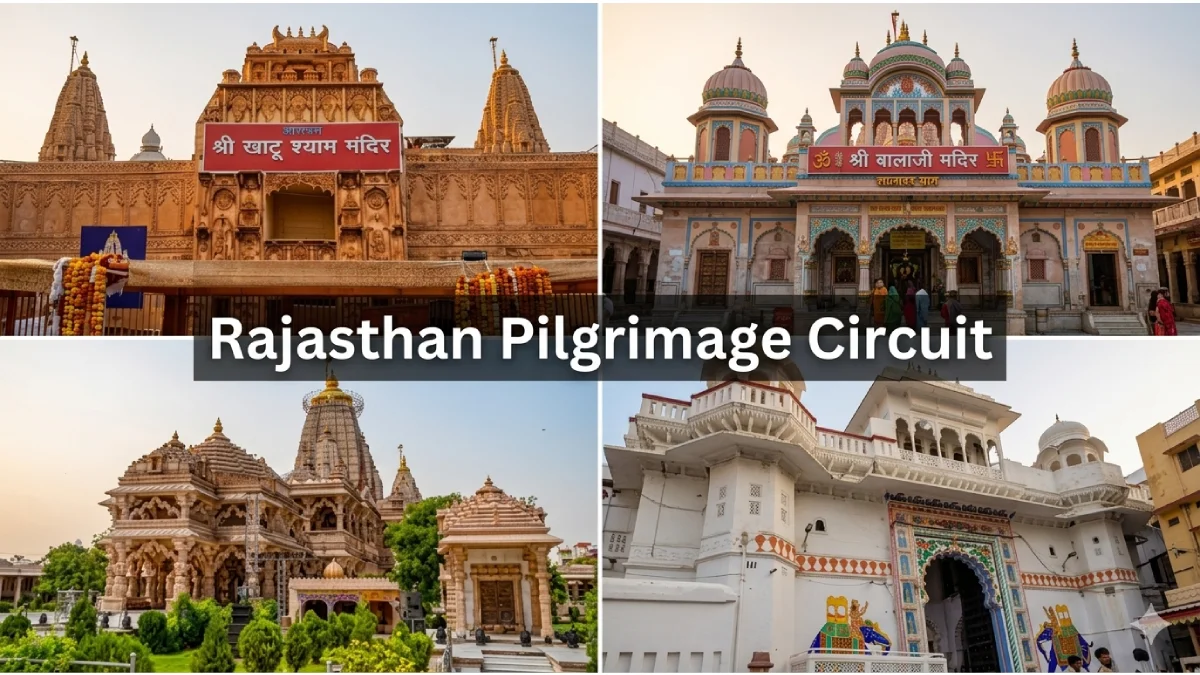
Rajasthan is famous the world over for its forts, palaces, and golden sands, but beneath the glitter of its royal heritage lies a deeply spiritual landscape that few travellers truly explore. From the idol of Khatu Shyam Baba in the Shekhawati region to the serene Brahma Mandir sitting beside Pushkar’s sacred lake, this state is home to some of Hinduism’s most powerful and beloved pilgrimage destinations. This 4-day Rajasthan Pilgrimage circuit connects six magnificent shrines in a logical, efficient route, starting from Jaipur and sweeping through northern and southern Rajasthan before ending at the holy town of Pushkar. Whether you are a devoted pilgrim, a curious traveller, or someone in between, this journey will leave you transformed.
“This is not just a road trip. It is a conversation with the divine, unfolding across 830 kilometres of Rajasthan’s sacred soil.”
Who is This Guide For?
This guide answers the questions most commonly searched by devotees and spiritual travellers planning a Rajasthan pilgrimage:
✦ Best route for Jaipur to Pushkar via Khatu Shyam and Salasar Balaji
✦ How to cover Khatu Shyamji, Salasar Balaji, Nathdwara and Pushkar in one trip
✦ Distance and travel time between pilgrimage sites in Rajasthan
✦ Temple timings and darshan tips for Rajasthan shrines
✦ 4-day pilgrimage itinerary in Rajasthan by road
✦ Sawaliya Seth temple how to reach from Jaipur
If any of these match what you were searching for- you’re in the right place.
The 6 Sacred Stops at Rajasthan Pilgrimage Circuit
| Leg | Distance | Drive Time | Best Departure |
| Jaipur → Khatu Shyamji | ~80 km | ~2 hrs | 5:00–5:30 AM |
| Khatu Shyamji → Salasar Balaji | ~130 km | ~3 hrs | 10:30 AM |
| Salasar Balaji → Sawaliya Seth | ~390 km | ~7–8 hrs | 6:00 AM (next day) |
| Sawaliya Seth → Nathdwara | ~80 km | ~2 hrs | 7:00 AM |
| Nathdwara → Pushkar | ~150 km | ~3.5 hrs | 7:00 AM |
Day 1- Jaipur to Khatu Shyamji to Salasar Balaji
Departure: Delhi/Jaipur
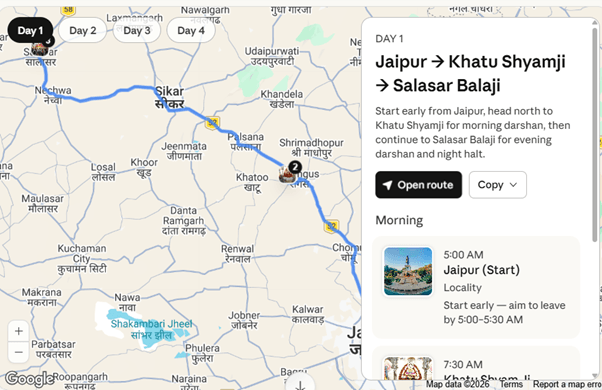
Your main pilgrimage trip begins in Jaipur, the Pink City, and the most well-connected city in Rajasthan. Jaipur serves as the ideal base for this circuit, with excellent road connectivity north toward Sikar and Churu.
Pro Tip: Leave Jaipur by 5:00–5:30 AM to reach Khatu Shyamji in time for the morning aarti and to avoid peak darshan queues. If you want to start the trip from Delhi, reach Jaipur one day earlier, explore palaces, and take enough rest for the next 4 days’ trip. To cover all these places without any exhaustion or hassle, tempo traveller hire in Delhi is the best way. It makes your trip flexible, safe and enjoyable.
Stop 1- Khatu Shyamji (Sikar, ~80 km from Jaipur)
Tucked inside the Sikar district in Rajasthan’s historic Shekhawati belt, the Khatu Shyam temple is one of North India’s most visited and emotionally charged pilgrimage destinations. The presiding deity- Shyam Baba, also known as Barbareek is believed to be a form of Lord Krishna who grants wishes unconditionally, earning him the title “Haare Ka Sahara” (The Refuge of the Defeated).
What Makes Khatu Shyam Special?
The idol here is unique- a face emerging from the earth, adorned with a marigold tilak and jewelled eyes that seem to follow you with an ineffable compassion. The temple complex is compact but powerful, and the bhajan mandap nearby rings with devotional music throughout the day.
Timing & Darshan
✦ Temple opens: 5:30 AM — ideal for Mangla aarti
✦ Busy days: Monday, Ekadashi, and the Phalguna Mela (Feb–March) draw massive crowds
✦ Allow 1.5 to 2 hours including prasad and a visit to the local market
✦ Famous offering: Ladoo prasad from temple counters
Foodie Note: The market lanes around the temple are lined with stalls serving kachori, jalebi, and chai- perfect for a light breakfast after darshan.
Stop 2- Salasar Balaji (Churu, ~130 km from Khatu Shyam)
From Khatu Shyamji, head northwest on the state highway toward Churu district. The drive through the flat, sun-baked Shekhawati plains takes about 2.5 to 3 hours and has good road quality.
Salasar Balaji is one of the most beloved Hanuman temples in all of India. Unlike most Hanuman idols- which depict the god with a muscular, warrior-like form- the Balaji here appears with a beard and moustache, a highly unusual and beloved distinction. The story of how this idol arrived at Salasar is itself a miracle tale passed through generations.
The Miracle of Salasar
Legend holds that the idol was found in a field while ploughing, and brought to Salasar on a bullock cart that stopped on its own at the precise spot where the temple now stands. Devotees believe that Balaji Maharaj chose his own home.
Timing & Darshan
✦ Temple hours: 6:00 AM to 9:00 PM daily
✦ Rated 4.8 on Google Maps with over 1 lakh reviews- a testament to its spiritual draw
✦ Arrive by 1:00–2:00 PM for afternoon darshan and lunch
✦ Night stay: Dharamshalas and budget hotels are available near the temple
Stay Recommendation: Spend the night at Salasar- the town has a peaceful, village-like energy, and the evening aarti is serene and uncrowded compared to daytime.
Find Here: Delhi to Jaipur Distance and Travel Time
Day 2- Salasar Balaji to Sawaliya Seth (Mandphiya)
The Longest Drive- Plan Carefully
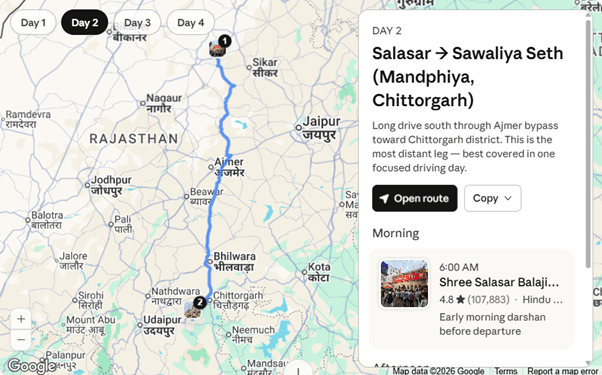
Day 2 is the most demanding driving day of the entire circuit. Sawaliya Seth temple, located in Mandphiya village near Chittorgarh, is approximately 390 kilometres from Salasar. The drive takes 7 to 8 hours via the Ajmer–Beawar bypass on NH-48.
Route: Salasar → Sikar → Jaipur bypass → Ajmer bypass → Bhilwara → Chittorgarh → Mandphiya. This avoids entering Jaipur city traffic entirely.
Depart by 6:00 AM after a brief morning darshan at Salasar Balaji. Drive through the wide open plains of central Rajasthan, passing the pink-hued town of Ajmer and the textile city of Bhilwara before arriving in Chittorgarh district by afternoon.
Stop 3- Sawaliya Seth Temple, Mandphiya (Chittorgarh)
The Sawaliya Seth temple is one of Rajasthan’s hidden gems- a Krishna temple that has become spectacularly famous among the business community and common devotees alike. The deity here is a dark-complexioned form of Lord Krishna, believed to bless his devotees with wealth, success, and the fulfillment of sincere wishes.
Who is Sawaliya Seth?
“Seth” means merchant or businessman in Hindi, and Sawaliya Seth is considered Lord Krishna in his role as the divine provider- a cosmic accountant who manages the accounts of devotion and grace. Stories of miraculous wish fulfillment have spread from this temple across Rajasthan and beyond. Many business families make it a point to visit before starting a new enterprise or after receiving a boon.
The Temple Complex
The temple at Mandphiya is actually one of three- the other two being at Bhadsoda and Chhapri. Together they form a tri-temple complex, and many devotees visit all three. The main temple is spacious, beautifully lit, and remarkably well-organised despite the heavy footfall.
Timing & Darshan
✦ Hours: 5:30 AM to 12:00 PM, then 2:30 PM to 11:00 PM
✦ Arrive by 2:30–3:00 PM to catch the reopening after the afternoon break
✦ Evening aarti is especially beautiful with flower offerings and conch shells
✦ Stay: Chittorgarh city (30 km away) has good hotel options- also worth visiting the famous Chittorgarh Fort
Bonus: If time permits, take the short evening detour to Chittorgarh Fort- a UNESCO World Heritage Site just 30 minutes away. It is hauntingly beautiful at dusk.
Check Here: Delhi To Jaipur Tempo Traveller Rates
Day 3- Sawaliya Seth to Nathdwara (Shrinathji)
A Short, Scenic Drive North
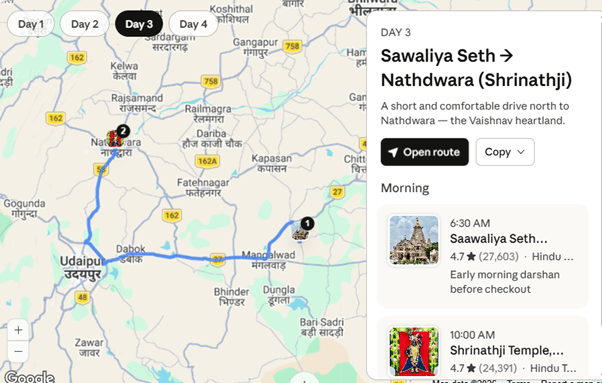
Day 3 is the most relaxed driving day, just 80 kilometres separating Mandphiya from Nathdwara, through the rolling hills and forests of southern Rajasthan. The road passes through charming Mewar countryside and the drive itself is a pleasure.
Leave after the 6:30 AM darshan at Sawaliya Seth and arrive in Nathdwara comfortably by 9:30 to 10:00 AM.
Stop 4- Nathdwara- Shrinathji Temple (Rajsamand)
Nathdwara- literally “Gateway of the Lord”, is one of Vaishnavism’s holiest towns and home to Shrinathji, a form of Lord Krishna as a seven-year-old child lifting the Govardhan mountain. The town exists almost entirely in service to the temple- its streets, markets, food, and art all revolve around the deity.
The Pichwai Tradition
Nathdwara is also the birthplace of Pichwai painting- large, intricate cloth backdrops depicting scenes from Krishna’s life that hang behind the deity during different seasons. Buying a genuine Pichwai from a local artist is one of the most meaningful souvenirs of this journey.
Darshan System- Book in Advance
The Shrinathji temple operates eight darshans daily, each with its own significance and ritual. The most important is the Rajbhog darshan, held around midday, when the deity is shown in full royal regalia with an elaborate food offering.
✦ Temple hours: 6:00 AM to 6:00 PM daily
✦ Rajbhog darshan: Book online at nathdwaratemple.org (₹350 per head — worth every rupee)
✦ Free darshan queue moves reasonably well on weekdays
✦ Rated 4.7 on Google Maps with 24,000+ reviews
✦ Must-try: Famous Nathdwara rabdi and chhappan bhog sweets from temple market
Foodie Note: Nathdwara’s local street food — especially the thick, creamy rabdi served in clay pots is deeply tied to the temple’s food offering tradition. Don’t miss it.
Optional Night Stay
Consider staying overnight at Nathdwara to catch an early morning darshan, alternatively, Udaipur is just 48 kilometres away and offers excellent hotel options, fine dining, and the romantic Lake Pichola for an evening visit.
Day 4- Nathdwara to Pushkar- The Final Blessing
The Road to Pushkar
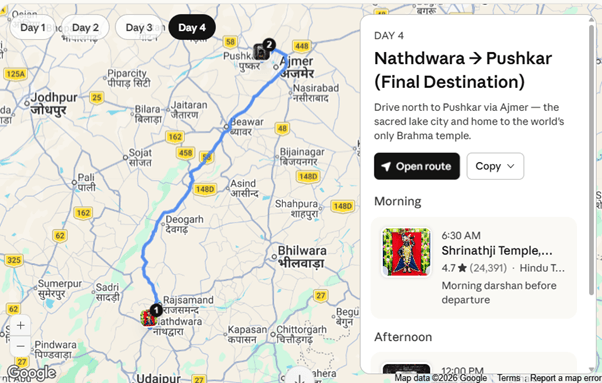
The final leg of this circuit is a 150-kilometre drive northward on NH-48 through the Aravalli hills toward Ajmer, and then a short climb into the Pushkar valley through the Nag Pahar Pass- a narrow, forested mountain road that opens dramatically onto the sacred town below. The drive takes around 3 to 3.5 hours.
Route Note: From Nathdwara, take NH-48 north toward Ajmer. After Ajmer, follow the Pushkar road over the Nag Pahar (Snake Mountain) pass. The ghat road is narrow- drive slowly and carefully.
Stop 5- Pushkar- The Lotus Town
Pushkar is unlike any other town in Rajasthan or in India. Ringed by the Aravalli hills, centered on a sacred lake, and permeated with an atmosphere of ancient holiness, Pushkar operates at a different spiritual frequency. It is simultaneously one of Hinduism’s seven sacred cities and a beloved destination for international travellers.
The Sacred Lake
The Pushkar Lake is believed to have been formed from a lotus petal dropped by Lord Brahma. All 52 ghats surrounding the lake have ritual significance. A holy dip here called the Pushkar Snaan is believed to wash away sins and liberate ancestral souls. The ghat priests will guide you through the ritual.
Stop 6- Jagatpita Shri Brahma Mandir
Pushkar is home to one of the world’s only temples dedicated to Lord Brahma- the Creator in the Hindu trinity. Despite Brahma being one of the three primary deities of Hinduism alongside Vishnu and Shiva, temples in his honour are extraordinarily rare due to a mythological curse. This red-spired, marble temple is therefore deeply significant and should not be missed.
✦ Rated 4.6 on Google Maps with 35,000+ reviews
✦ Best visited in the early morning for a peaceful, crowd-free darshan
✦ The evening aarti at Brahma Ghat and Varaha Ghat is a soul-stirring experience
✦ Pushkar bazaar offers rudraksha, silver jewellery, and rose products
✦ Famous food: Malpua, gulkand lassi, and the vegetarian thalis at lakeside cafes
“At the Pushkar ghats as the sun sinks behind the Aravalli hills and conch shells ring across the water, you understand why pilgrims have been coming here for thousands of years.”
Stay Tip: Pushkar rewards an overnight stay. Rise early to witness the magical dawn aarti at the lake — a moment that stays with you long after the journey ends.
Complete Practical Guide
Best Time to do Pilgrimage Tour in Rajasthan
✦ October to March: Ideal- cool weather, clear skies, festive atmosphere
✦ Pushkar Camel Fair (Nov): Spectacular but extremely crowded- book hotels 3 months ahead
✦ Phalguna (Feb–March): Khatu Shyam Mela draws over 10 lakh devotees- visit before or after the main dates
✦ Avoid May–June: Rajasthan summers are severe (45°C+)
Transport Options
✦ Private car/cab: Most comfortable and flexible — highly recommended for pilgrimage groups
✦ Self-drive: Good roads throughout; NH-48 is excellent; Nag Pahar pass to Pushkar requires caution
✦ Trains: Jaipur–Sikar (Khatu Shyam), Jaipur–Ajmer–Pushkar; no direct rail to Salasar or Nathdwara
✦ Budget tip: Hire a local cab from Jaipur for the full 4-day circuit- negotiate a fixed package rate
Budgeting the Trip
✦ Accommodation: ₹800–₹2,500 per night (dharamshala to mid-range hotel)
✦ Fuel/cab (4 days, ~850 km): ₹6,000–₹10,000 depending on vehicle
✦ Meals: ₹150–₹400 per person per day (vegetarian only- all these are temple towns)
✦ Nathdwara Rajbhog darshan: ₹350 per head
✦ Total estimated budget (2 persons): ₹8,000–₹18,000 excluding major shopping
Important Dos and Don’ts
✦ Dress modestly at all temples — cover shoulders and knees; carry a dupatta or stole
✦ Remove shoes before entering all temple premises
✦ Photography is restricted inside most shrines — ask before clicking
✦ All these towns are strictly vegetarian — avoid asking for non-vegetarian food
✦ Carry cash — many smaller shops and prasad counters don’t accept cards or UPI
✦ Avoid visiting on Ekadashi at Khatu Shyam and Salasar — queues can be 4–6 hours long
✦ Book Nathdwara Rajbhog darshan at least 3–5 days in advance online
Final Thoughts- A Journey Worth Taking
This six-shrine circuit through Rajasthan is more than a trip, it is a pilgrimage of the heart. Each temple on this route carries its own energy, its own mythology, and its own way of opening the devotee to something larger than themselves.
Khatu Shyam comforts the defeated. Salasar Balaji strengthens the seeker. Sawaliya Seth blesses the striving. Shrinathji nourishes the soul. And Pushkar which dissolves all that remains into the waters of grace.
Travel this route with an open heart, early mornings, and no particular rush. The divine, after all, is never in a hurry. Book a complete package with Urbania Van on Rent in Delhi and travel in extreme comfort.
Jai Shree Shyam. Jai Bajrang Bali. Jai Shrinathji.
