

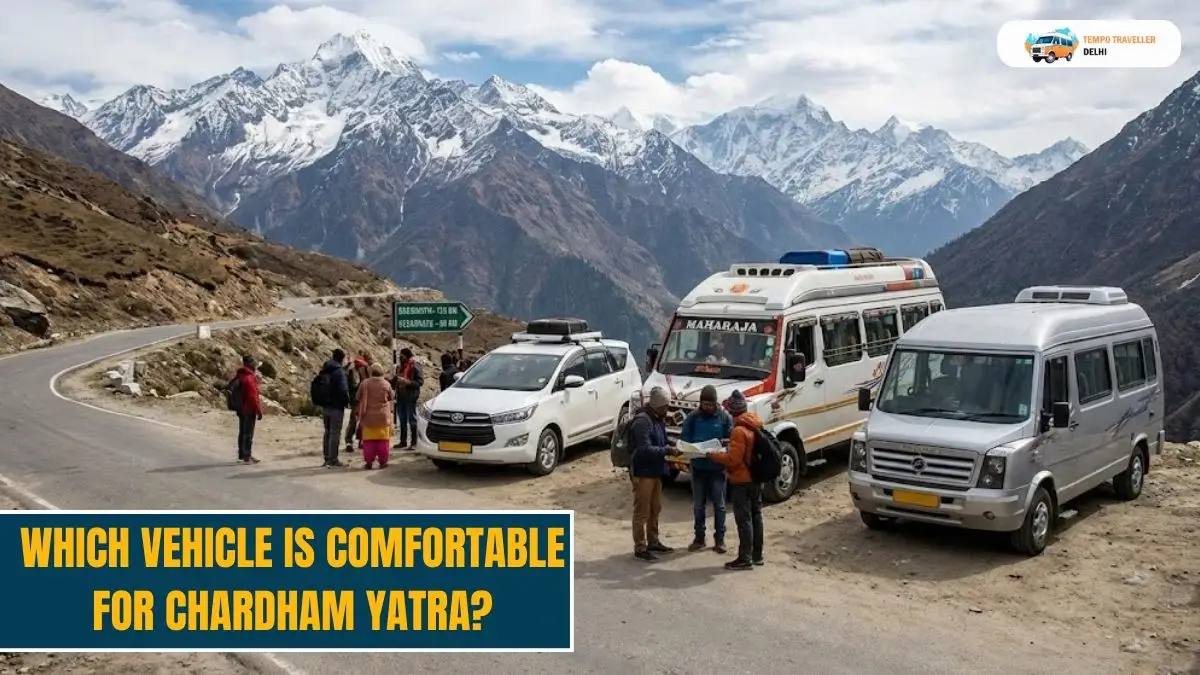
Let’s be honest: the Chardham Yatra isn’t just a trip; it’s a marathon for the soul. Between the winding roads of the Garhwal Himalayas and the thin air of Kedarnath, your body takes a beating. I’ve seen pilgrims arrive at the shrines completely drained, not because of the trek, but because they spent ten hours bouncing around in a vehicle that wasn’t built for these terrains. The mountains are unforgiving, and the road from Haridwar to Badrinath is a long, winding test of endurance.
Choosing the right set of wheels is probably the most underrated part of your planning. You’re going to cover over 1,600 km on roads that twist like ribbon, often with steep drops on one side and jagged cliffs on the other. If you’re wondering Which vehicle is Comfortable for Chardham Yatra?, the answer depends entirely on your group size, your budget, and how much you value your lower back after a week of mountain driving.
In this guide, you’ll get the ground reality for the upcoming 2026 season. We’ll cover the confirmed temple opening dates, a deep dive into the pros and cons of the best vehicles available, and a realistic budget breakdown so you aren’t hit with “hidden costs” halfway to Badrinath. By the end of this read, you will have a clear blueprint for your transport logistics.
Chardham Yatra 2026: Official Dates and Timing
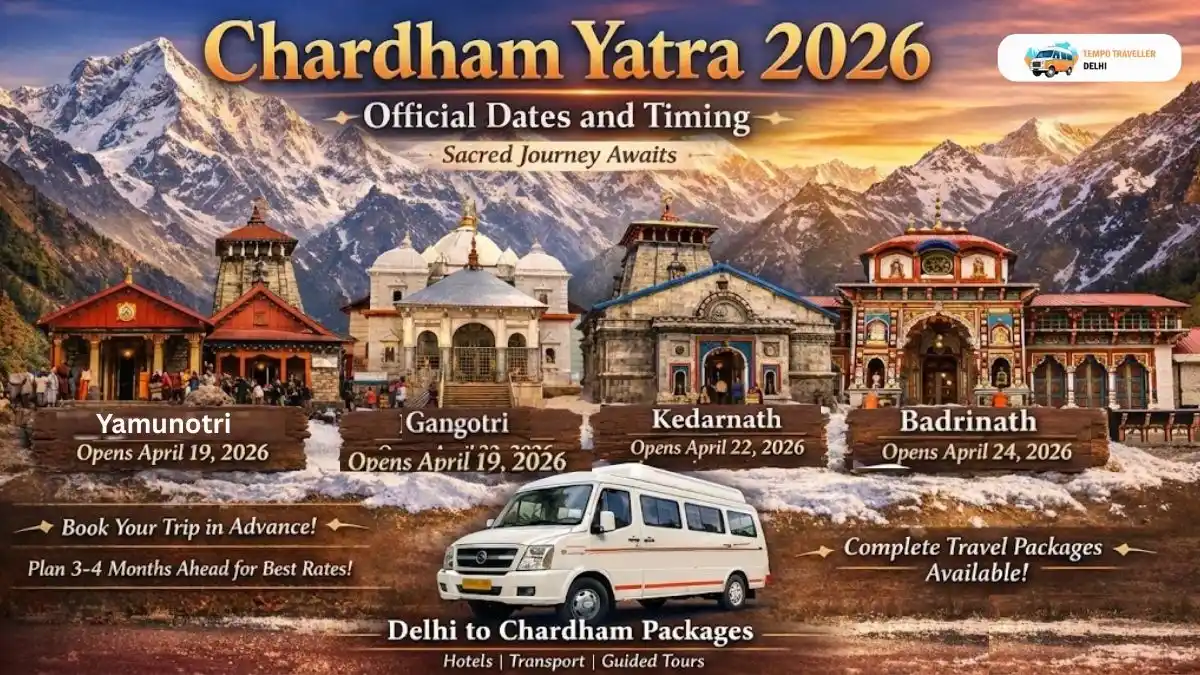
The 2026 season officially starts on Akshaya Tritiya, a day considered highly auspicious in the Hindu calendar. Based on current astrological alignments and local administrative briefings, here are the dates you need to mark:
- Yamunotri & Gangotri: These temples traditionally open on the day of Akshaya Tritiya, which falls on April 19, 2026.
- Kedarnath: Usually opens a few days later, tentatively April 22, 2026, following the ritualistic announcements at Omkareshwar Temple.
- Badrinath: Expected to open around April 24, 2026, after the traditional ceremony in Tehri.
- Closing Dates: These are generally within 2-3 days of Diwali (early November 2026), depending on the first heavy snowfall.
Planning your vehicle booking at least 3-4 months in advance for these dates is crucial, as the demand for luxury carriers spikes significantly during the “shubh mahurat” (auspicious timing). Or If you are looking for a complete solution including hotels and transport, check out our comprehensive Chardham Yatra Tempo Traveller Rates from Delhi to handle all the logistics for you.
The Landscape: Why Your Choice Matters
Before we jump into the models, you need to understand the terrain. The “All-Weather Road” project has significantly improved the highway from Rishikesh to Joshimath, but “improved” doesn’t mean “flat.” You will still encounter narrow bypasses, gravelly patches near landslide zones, and steep inclines that require a high-torque engine.
When people ask Which vehicle is Comfortable for Chardham Yatra?, they often forget about the “Ground Clearance” factor. A vehicle with low clearance will scrape its belly on the rocky paths near Sonprayag or Janki Chatti, causing delays and safety concerns. You need a machine that can breathe in thin air and a cabin that keeps the Himalayan chill away.
Comparing Your Best Options: Which vehicle is Comfortable for Chardham Yatra?
1. Toyota Innova Crysta (The Gold Standard)
- What it is: A premium 6+1 seater SUV that has become the undisputed king of the Indian hills.
- Ideal Group: Families of 4 to 5 people who want a private, car-like experience.
- Comfort: Top-tier. The captain seats in the middle row are a lifesaver on the long stretch between Pippalkoti and Badrinath. It features independent rear AC cooling and superior shock absorbers.
- Pros: Incredible “pull” on steep inclines; high safety rating; powerful AC for the lower altitude stretches (like the humid Haridwar-Rishikesh belt). It handles “hairpin bends” with minimal body roll.
- Cons: Limited luggage space if you have 6 passengers. You’ll almost certainly need a roof carrier for a 10-day trip.
- Cost Range (2026): ₹6,500 – ₹7,800 per day (all-inclusive for 2026 projections).
- When to avoid: If you are a group of 7+ adults; the third row is cramped for grown-ups on long mountain journeys.
2. Force Tempo Traveller (The Maharaja Edition)
- What it is: A modified 12 Seater Maharaja Tempo Traveller or 26-seater van specifically built for long-distance group tours.
- Ideal Group: Large extended families or friend groups (8–15 people).
- Comfort: Good, especially the “Maharaja” 1×1 or 2×1 seating configuration. These versions offer push-back seats and more legroom than a standard commuter bus.
- Pros: You all stay together, which adds to the “Yatra” vibe – singing bhajans or sharing stories. High ground clearance is great for monsoon-damaged roads.
- Cons: It’s a large vehicle, so it’s slower on narrow mountain curves. The back row can be quite bumpy on uneven roads.
- Cost Range (2026): ₹9,500 – ₹11,500 per day.
- When to avoid: If your group is prone to severe motion sickness. Large vans sway more on the 180-degree turns of the Garhwal range.
3. Force Urbania (The Luxury Disruptor)
- What it is: The newest entry into the luxury van segment, featuring a wide-body design and European styling.
- Ideal Group: 10–13 people who want the absolute best and don’t mind paying a 20% premium.
- Comfort: Exceptional. It has much lower NVH (Noise, Vibration, Harshness) levels than the older Tempo Travellers. It feels more like a luxury coach.
- Pros: Panoramic windows that give you a 180-degree view of the Alaknanda river; individual AC vents; very stable on high-altitude turns.
- Cons: It’s expensive, and because it’s a newer model, finding a replacement or specific parts in remote areas like Harsil can be a challenge.
- Cost Range (2026): Force Urbania Van on rent costs you around ₹13,000 – ₹15,500 per day.
- When to avoid: If you are traveling to very remote off-beat villages where the roads are barely wide enough for a jeep.
4. Mahindra Scorpio-N or XUV700 (The Rugged Alternatives)
- What it is: Powerful Indian SUVs with 4×4 or high-torque capabilities.
- Ideal Group: 3 to 4 young travelers or photography enthusiasts.
- Comfort: Solid, but more “rugged” than “plush.”
- Pros: They can go where even an Innova might struggle. Great for those who want to explore side-roads near Chopta or Auli.
- Cons: Less cabin space compared to an Innova; the suspension is tuned for off-roading, which can feel stiff on paved highways.
- Cost Range (2026): ₹6,000 – ₹7,000 per day.
Why You Should Avoid Sedans and Hatchbacks
Many pilgrims try to save money by taking a Maruti Dzire or a Honda City. This is a mistake. These cars have low ground clearance and small tires. The Chardham route involves crossing several “nullahs” (water streams) that flow over the road. A sedan is likely to get stuck or damage its undercarriage. Furthermore, the engines of small hatchbacks often struggle with the lack of oxygen at 10,000+ feet, leading to overheating.
Practical Booking Checklist for 2026
Don’t just look at the vehicle; look at the paperwork and the person behind the wheel.
- The “Green Card”: This is a mandatory fitness and permit document issued by the Uttarakhand Transport Department. Ensure your driver has a valid one for 2026.
- The “Pahadi” Driver Factor: Driving in Delhi or Mumbai is nothing like driving to Kedarnath. Ensure your driver has at least 5 years of experience in the Garhwal Himalayas. They should know how to use “engine braking” on descents rather than riding the brakes.
- The Luggage Strategy: Himalayan rain is legendary. Even in May, a sudden downpour is common. If your luggage is on the roof, ensure the operator provides a heavy-duty, waterproof tarpaulin and bungee cords.
- Carrier Capacity: Ensure the vehicle carrier is rated for the weight you’re bringing. Overloading a vehicle changes its center of gravity, which is dangerous on mountain curves.
Also Read: How to Reach Chardham from Delhi
10-Day Budget for Char Dham Yatra
| Expense Item | Innova Crysta (6 Pax) | Tempo Traveller (12 Pax) |
| Total Vehicle Rental (10 Days) | ₹75,000 | ₹1,10,000 |
| Driver Allowance (Bata) | Included | Included |
| State Taxes (UK, UP, DL) | ₹5,000 | ₹9,500 |
| Parking & Toll Fees | ₹2,500 | ₹4,000 |
| Approx. Total Cost | ₹82,500 | ₹1,23,500 |
| Cost Per Person | ₹16,500 | ₹10,291 |
Note: These are estimates. Prices often fluctuate based on diesel rates and peak-season demand.
Critical Medical and Comfort Tips
Regardless of which vehicle is Comfortable for Chardham Yatra, the way you sit and travel matters.
- Hydration: Keep a crate of water in the boot. Dehydration accelerates Altitude Mountain Sickness (AMS).
- Motion Sickness: Carry Avomine or ginger candies. The stretch from Rishikesh to Barkot has over 100 sharp turns.
- Layering: The temperature inside the car can be 25°C, but when you step out at Badrinath, it could be 4°C. Keep your jackets accessible, not buried in the roof luggage.
Final Recommendation
To conclude, If you are a small family and your budget allows for it, book the Toyota Innova Crysta. It is the most reliable, comfortable, and safest way to navigate the mountains. However, if you are traveling with a larger group (8-12 people), the Force Urbania is the modern choice for 2026, offering a level of comfort that the older Tempo Travellers simply cannot match.
The journey to the feet of the Gods should be one of reflection and peace, not one of backaches and mechanical breakdowns. Choose your ride wisely.
